
AI Agents vs. Regular Chat: What’s the Real Difference in Proposal Writing?
- Jan 5
- 3 min read
Many government contractors are already using tools like ChatGPT to support proposal writing. Common use cases include reviewing RFP sections, generating compliance matrices, comparing drafts to evaluation criteria, and identifying gaps or inconsistencies.
A natural question follows:
If ChatGPT can already do all of this in a regular chat, what’s the point of using an AI agent?
The answer isn’t that AI agents are “smarter.” The difference comes down to structure, repeatability, and control—three things that matter a great deal in government proposals.
Regular Chat: Flexible, but One-Off
When you use ChatGPT in a standard chat window, you’re working in a conversational, ad hoc way. You paste content, describe what you want, and adjust as you go. This can be very effective, especially for exploration or one-time tasks.
For example, you might ask:
“Review this RFP section and extract all requirements.”
ChatGPT will usually produce a helpful response. However:
The format may change each time
The level of detail may vary
You often need to restate instructions
There’s no built-in consistency from one task to the next
Regular chat is great for thinking, brainstorming, and experimenting—but it relies heavily on how each individual prompt is written in the moment.
AI Agents: Structured and Repeatable
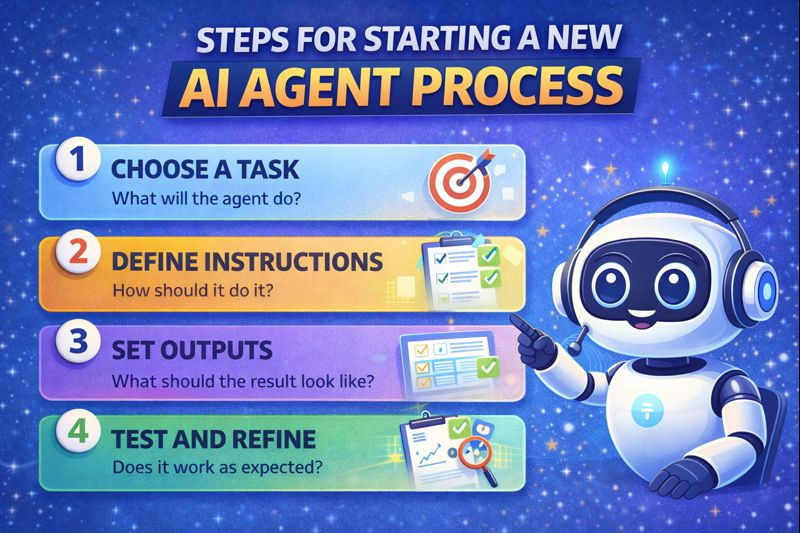
An AI agent is best understood as a predefined role with fixed instructions and expected outputs. It’s not autonomous and it’s not making decisions on its own. Instead, it applies the same logic and rules every time it’s used.
For example, an AI agent might be instructed as:
“You are a Compliance Review Agent. Extract all mandatory requirements from the RFP section and present them in a table with the requirement source, requirement text, and proposal response location.”
Each time that agent is used:
The same logic is applied
The same format is produced
The same rules are followed
This consistency is where AI agents become especially useful in proposal environments.
Why the Difference Matters in Government Proposals
Consistency Reduces Risk
Government proposals are evaluated on compliance, traceability, and clarity. Inconsistent analysis across sections or volumes can introduce risk—even if each individual response looks reasonable.
AI agents help ensure that:
Requirements are extracted the same way every time
Compliance matrices follow a consistent structure
Reviews are applied evenly across sections
This makes the proposal easier to manage and easier to defend internally.
Easier Quality Control
With regular chat, outputs depend heavily on how the question was phrased that day. With agents, teams can say:
“This is how we perform compliance checks.”
That makes it much easier to review, validate, and trust the outputs—especially on large or complex solicitations.
Better for Team Environments
For solo users, regular chat may be enough. But as soon as multiple writers or reviewers are involved, consistency becomes harder to maintain.
AI agents allow teams to:
Use the same logic across contributors
Reduce interpretation differences
Onboard junior staff more quickly
Maintain standards across volumes and drafts
How This Applies to Common Proposal Tasks
Reviewing RFP Sections
Regular chat: Works, but results may vary by prompt
AI agent: Always extracts requirements using the same rules
Generating Compliance Matrices
Regular chat: Format and depth may change
AI agent: Produces consistent tables aligned to instructions
Comparing Drafts to Evaluation Criteria
Regular chat: Subjective and variable
AI agent: Applies a fixed rubric every time
Identifying Gaps or Inconsistencies
Regular chat: Helpful, but inconsistent
AI agent: Flags the same issue types across sections
A Simple Way to Think About It
Here’s a practical way to frame the difference:
Regular chat is good for thinking. AI agents are good for execution.
Proposal teams need both—but execution is where consistency and discipline matter most.
When Regular Chat Is Enough
Early RFP exploration
Small or low-risk opportunities
One-off tasks
Solo proposal work
When AI Agents Make Sense
Large or compliance-heavy RFPs
Multiple writers or reviewers
Tight deadlines
Repeated proposal work over time
You don’t need AI agents to use AI effectively. But if your goal is to reduce rework, improve consistency, and scale proposal support safely, AI agents provide a more disciplined way to apply AI in proposal writing.
The key isn’t automation—it’s intentional use.
Used correctly, AI agents support strong proposal fundamentals. Used carelessly, they introduce risk. As with any proposal tool, judgment, strategy, and compliance still belong to humans.


Comments